Introduction
Organizations are living systems, born from human intention and sustained through their relationships. Yet over time, many drift from their original spirit, becoming trapped within inherited structures that are focused on extraction rather than regeneration. What begins as a vibrant collaborative organism can harden into something more mechanical. Still functional and efficient perhaps, but brittle and disconnected from its authentic purpose.
When organizations experience mission drift or values misalignment, they often need more than tactical adjustments. They need a process of remembering who they really are at their core.
I create space for organizations to reconnect with their authentic purpose. I guide them in transforming hierarchical, extraction-based systems into collaborative, stakeholder-centered approaches that honor both effectiveness and humanity.
My theoretical foundation draws from systems thinking and sympoietic principles: the understanding that living systems create themselves together, in cooperation. This work mirrors personal transformation, and there are four distinct phases of coming to authenticity: understanding/waking-up, remembering what is authentic in ourselves, visioning that authentic self in the world, and companionship on the ensuing journey.
Deep Listening & Understanding
Every authentic transformation begins with deep listening and the kind of witnessing that allows an organization to tell its complete story. Most organizations have never been invited to reveal their full truth: the gap between stated values and lived experience, the wisdom held by those at the margins, the tensions that hum beneath polished mission statements.
This phase creates space for that truth-telling. My role becomes less consultant and more ethnographer, listener, witness, and I approach the organization as a living being whose patterns can be traced and whose story deserves to be heard without judgment.
How I Work
What Emerges
The organization begins to see itself clearly, often for the first time. Unspoken tensions come into the light. Hidden wisdom—often carried by frontline staff or long-time community members—receives acknowledgment. The disconnect between aspiration and lived reality gets named without shame.
Most importantly, the organization begins to recognize not just its challenges but its latent strengths, the places where its authentic nature already reveals itself despite systemic constraints.
Why This Matters Philosophically
Organizations must first wake up to what actually IS before they can change. Deep listening grounds transformation in reality. This phase builds the foundation of trust necessary for collaborative change. When people feel truly seen and heard, they become willing partners in transformation.
What emerges from authentic listening creates readiness for the remembering that follows.
Collaborative Remembering
Phase 2 helps the organization remember what is authentic by reconnecting with original purpose and deepest values. The goal of healing isn't to install something new from the outside, but to guide the system back to truths it already carries within. Layers of survival, compliance, and adaptation can bury that core identity over time. Collaborative Remembering gently unearths it together.
This remembering cannot happen in isolation—no leader can do it alone, no consultant can deliver it from outside. It requires the collective wisdom of everyone who carries part of the organization's authentic story.
How I Work
What Emerges
The organization reconnects with its core identity—not who it thinks it should be, but who it actually is when functioning from its highest values. Often this feels like remembering something that was always true but had been forgotten.
People rediscover shared purpose that goes beyond individual job descriptions or departmental goals. The organizational soul becomes visible and nameable.
Why This Matters Philosophically
Organizations remember who they really are beneath the accumulated patterns and structures. Authentic transformation cannot be imposed from outside—it must emerge from the organization's own deepest truth. This phase reconnects the system with its essential nature and creates alignment around what truly matters.
Gentle Integration
Phase 3 explores how to embody authenticity in the world through "soul-of-the-org prototyping." This is where vision meets reality, where the organization experiments with living its truth within the constraints and opportunities of its actual context.
Rather than imposing change, this phase creates space for the organization to discover how its authentic identity wants to express itself through structure, culture, and daily practice.
How I Work
What Emerges
The organization develops practical ways to live its values without sacrificing effectiveness. New structures and practices emerge that feel both grounded and inspiring. People experience what it's like to work in alignment with authentic purpose rather than against it.
Change happens through experimentation rather than mandate, creating ownership and organic adoption of new ways of being.
Why This Matters Philosophically
Authenticity requires experimentation—learning how to live your truth in the world. Integration is creative experimentation rather than mechanical implementation. This phase helps organizations prototype their soul, discovering sustainable ways to embody their values in their specific context.
Ongoing Guidance & Facilitation
Authentic transformation requires ongoing companionship and support—it's not a destination but a practice. Living authentically as an organization means continually navigating the tensions between ideals and practical constraints, between individual needs and collective purpose.
This phase provides the steady relationship that supports continued evolution and helps the organization stay connected to its authentic self through changing circumstances.
How I Work
What Emerges
The organization develops internal capacity to navigate change while maintaining connection to its authentic purpose. Rather than reverting to old patterns under pressure, it learns to use challenges as opportunities to deepen into its values.
Sustainable transformation becomes a way of life rather than a one-time intervention.
Why This Matters Philosophically
Living authentically requires ongoing companionship and support—it's not a destination but a practice. Sustainable change happens in relationship, not isolation. Organizations need steady, trusted companions for continued evolution toward their highest expression.
Transformation as Homecoming
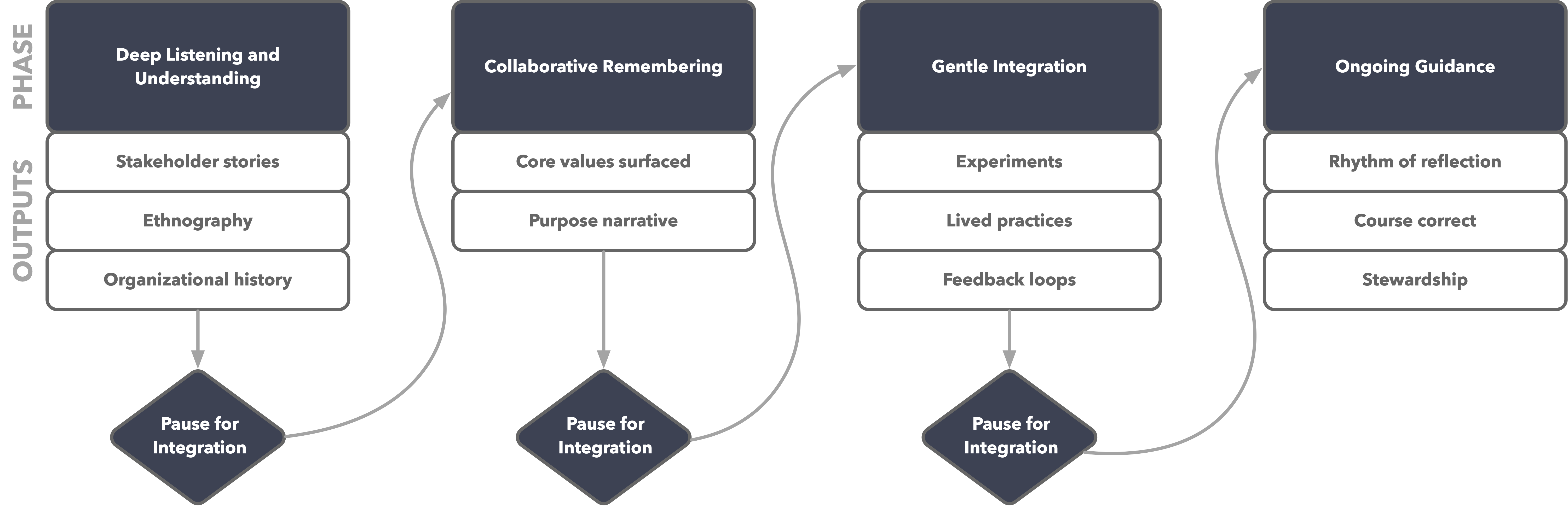
These four phases—Deep Listening, Collaborative Remembering, Gentle Integration, and Ongoing Guidance—create a process that feels less like external intervention and more like homecoming. Together, they help organizations move from command-and-control structures toward collaborative, regenerative systems that honor both effectiveness and humanity.
What organizations gain is not just better systems or clearer strategies but fundamental coherence. They remember who they are, why they exist, and how to embody that truth in daily practice. The work transcends problem-solving to reconnect organizations with their wholeness.
When organizations choose this path, the commitment is ultimately to themselves—to stepping into a process that requires honesty, imagination, patience, and courage. It means choosing the deeper work of alignment over quick fixes, trusting that wisdom already lives within the system, waiting to be heard and honored.
The difference is profound. Traditional approaches leave organizations chasing the next crisis or copying external models. This methodology gives them an internal compass that can guide them through uncertainty toward authentic expression of their unique purpose and values.
The result isn't perfection but aliveness: organizations that breathe, adapt, and grow in integrity with their soul.